Duodenal Switch Information Zone

Search the Duodenal Switch Information Zone!

Search Query

Read and Post in the Duodenal Switch Support Forums!

1998 Scopinaro Report

The entire contents of this page are used with permission, and are copyright ©1998 by Nicola Scopinaro, MD, et al, all rights reserved. Text, graphics, and HTML code are protected by US and International Copyright Laws, and may not be copied, reprinted, published, translated, hosted, or otherwise distributed by any means without explicit permission. Reprint requests should be directed to Nicola Scopinaro, MD, Istituto di Clinica Chirurgica dell’Università, Ospedale S. Martino, 16132 Genova, Italy.

BILIOPANCREATIC DIVERSION
Nicola Scopinaro, MD, Professor of Surgery
Gian Franco Adami, MD, Associate Professor of Surgery
Giuseppe M. Marinari, MD, Assistant Professor of Surgery
Ezio Gianetta, MD, Associate Professor of Surgery
Enrico Traverso, MD, Assistant Professor of Surgery
Daniele Friedman, MD, Assistant Professor of Surgery
Giovanni Camerini, MD, Assistant Professor of Surgery
Giorgio Baschieri, MD, Resident
Alessabdro Simonelli, MD, Resident
Department of Surgery, University of Genoa School of Medicine, Genoa, Italy

Reprint requests:
Nicola Scopinaro, MD
Istituto di Clinica Chirurgica dell’Università
Ospedale S. Martino
16132 Genova, Italy

Table of Contents:
Abstract
Introduction
Case Material
Eating Habits
Bowel Habits
Weight Loss
Weight Maintenance
Other Beneficial Effects
Nutrition
Aspecific Complications
Specific Late Complications
    
Anemia
    
Stomal ulcer
    
Bone demineralization
    
Neurologic complications
    
Protein malnutrition
Minor Or Rare Late Complications
Late Mortality
Elongations And Restorations
Conclusions
References
 

ABSTRACT

Biliopancreatic diversion (BPD) has made reacceptable the malabsorptive approach to the surgical treatment of obesity. The procedure, in a series of 2241 patients operated on during a 21 years period, caused a mean permanent reduction of about 75% of the initial excess weight. The indefinite weight maintenance appears to be due to the existence of a threshold absorption capacity for fat and starch, and thus energy, while the weight loss is partly due to increased resting energy expenditure. Other beneficial effects, besides those consequent to weight loss and/or reduced nutrient absorption, included permanent normalization of serum glucose and cholesterol without any medication and on totally free diet in 100% of cases, both phenomena being due to a specific action of the operation. Operative mortality was less than 0.5%. Specific late complications included: anemia, less than 5% with adequate iron and/or folate supplementation; stomal ulcer, reduced to 3.2% by oral H2-blockers prophylaxis; bone demineralization, increasing up to the fourth year and tending to decrease thereafter, with need of calcium and vitamin D supplementation; neurological complications, totally avoidable by prompt vitamin B administration to patients at risk; protein malnutrition, which was reduced to a minimum of 3% with 1.3% recurrence, in exchange with a smaller weight loss, by adapting the volume of the gastric remnant and the length of the alimentary limb to the patient’s individual characteristics. It is concluded that the correct use of BPD, based on the knowledge of its mechanisms of action, can make the procedure a very effective and safe one in all hands.

back to top

INTRODUCTION

The high complication rate and the overall unsatisfactory weight loss results of jejunoileal bypass (JIB) led in the years around 1980 to general abandoning of malabsorption approach for obesity surgery, the gastric restriction procedures becoming the currently used ones. Besides its complications, essentially due to the indiscriminate malabsorption and to the harmful effects of the  long blind loop, the main problem with JIB is its narrow “therapeutic interval”. In fact, the total length of the small bowel left in continuity is restrained within the range of 40 to 60 cm, a shorter or longer bypass resulting in life-threatening malabsorption or no weight reduction, respectively. On the other hand, the massive intestinal adaptation phenomena cause an increase of the absorptive surface leading out of the upper limits of the above range, with ensuing substantial recovery of energy absorption capacity. This, in addition to the frequent need of restoration for major complications, ends in a high rate of failure with weight regain (1,2).

Because of the absence of a blind loop and of the malabsorption essentially selective for fat and starch, biliopancreatic diversion (BPD) is free of the complications pertaining to JIB (3,4). Moreover, BPD has a very wide “therapeutic interval”, since, by varying the length of the intestinal limbs, any degree of fat, starch and protein malabsorption can be created, thus adapting the procedure to the population’s or even the patient’s characteristics, in order to obtain the best possible weight loss results with the minimum of complications (5). This extreme flexibility also allows to neutralize the consequences of intestinal adaptation phenomena, which, on the other hand, are little effective in BPD. The qualities of BPD have gradually led to reacceptance of malabsorption as a surgical approach to obesity therapy, the procedure being increasingly used in all the Western World in its numberless possible versions.

Results and complications of BPD, after more than twenty years of clinical use, are well known by all bariatric surgeons. Therefore, the main purpose of this article is to describe the physiology of the operation, whose knowledge has considerably increased in the last years. The full understanding of the mechanisms of action of BPD is of paramount clinical importance, since it enables any surgeon to exploit the ductility of the procedure in order to adapt it to its particular patients’ population.

back to top

CASE MATERIAL

Of the total series of 2241 patients operated on since May 1976, 1356 (438 men and 918 women) underwent the present “ad hoc stomach” (AHS) type of BPD performed by the same surgical team between June 1984 and April 1997. Mean age was 37 years (11-70), mean weight 128 kg (73-236), and mean excess weight was 69 kg (20-156), corresponding to 117% (41-311) and to a mean BMI of 47 kg/m2 (29-87). Maximum follow-up was 155 months. Follow-up rate was 98%.

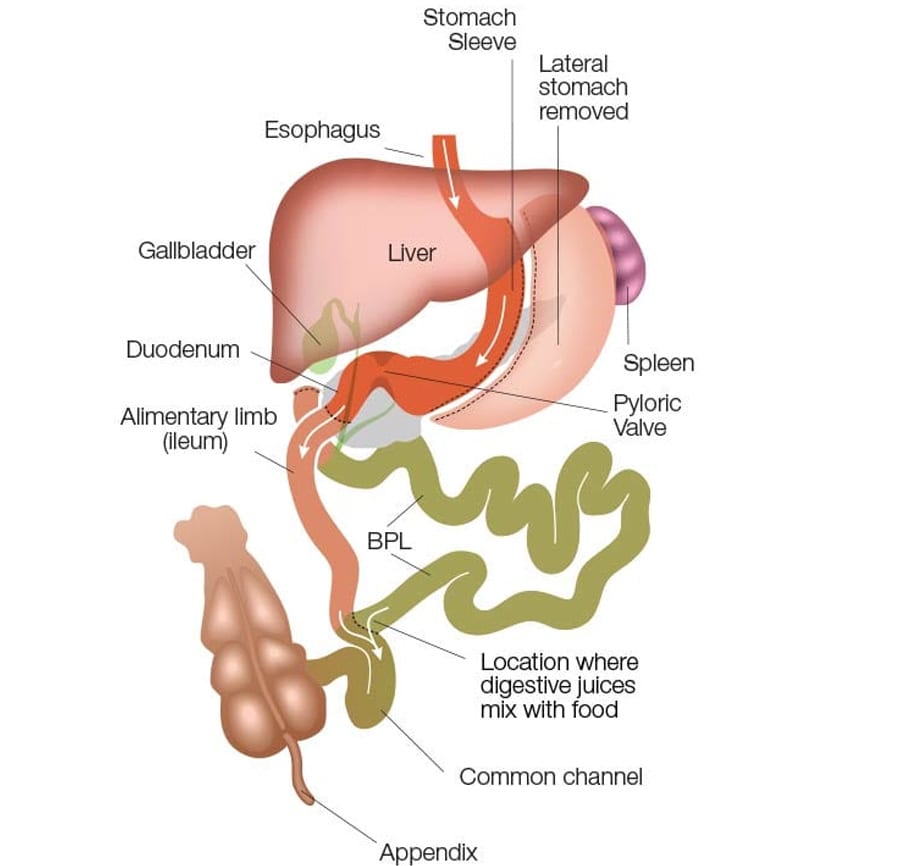
In the AHS BPD (Fig. 1) the gastric volume, which is the main determinant of the initial weight loss (temporary food intake limitation due to decrease of appetite and occurrence of postcibal syndrome), is adapted to the preoperative excess weight and to other individual characteristics (such as sex, age, eating habits, social-economical status and expected degree of compliance), with the aim of attaining in all cases the weight of maintenance around the end of the first postoperative year with the minimum of nutritional complications (6). Intestinal lengths, which determine energy absorption and thus the weight of stabilization and its indefinite maintenance, were adapted to the patient’s characteristics only in the last five years (as described below).

back to top

EATING HABITS

During the first postoperative months all patients undergoing BPD, due to the food stimulation of the ileum (7), have reduced appetite, and they have early satiety, occasionally in association with epigastric pain and/or vomiting. These symptoms characterize the postcibal syndrome and are caused by rapid gastric emptying with subsequent distention of the postanatomotic loop. All these symptoms, the more intense and lasting the smaller the gastric volume, rapidly regress with time, most likely due to intestinal adaptation. One year after operation the appetite and the eating capacity are fully restored and patients mean reported food intake is one and a half time as much as preoperatively, independently of gastric volume. Patients undergoing BPD must be aware that for the rest of their lives they will absorb minimal fat (8), little starch, sufficient protein (8,9), and nearly all mono and disaccharides, short-chain triglycerides, and alcohol (i.e., the energy content of sugar, fruit, sweets, soft drinks, milk, and alcoholic beverages). They must also understand that when their body weight will have reached the level of stabilization the intake of these aliments may be varied as needed for individual weight adjustments.  

Interestingly, the vasomotory phenomena characterizing the dumping syndrome are always absent after BPD, this indicating the lack in the ileum of the specific receptors and/or the vasoactive gut hormones which are thought to be implicated in the pathogenesis of d.s.

back to top

BOWEL HABITS

After full resumption of food intake, BPD subjects generally have two to four daily bowel movements of soft stools. All have foul smelling stools, and most have flatulence. These phenomena, which can be reduced by modifying eating habits or by neomycin or metronidazole administration, tend to decrease with time along with a reduction of bowel movement frequency and an increase of stool consistency. Diarrhea usually appears only in the context of postcibal syndrome, and then it rapidly disappears, being practically absent by the fourth month (5).

The absence of diarrhea after BPD is easily explained considering that, unlike following JIB, the loss of bile salt into the colon was calibrated to about 750 mg/day by choosing the appropriate length for the common limb (8), and that, due to the lack of fat digestion, steatorrhea is essentially neutral, fecal pH resulting around 7. In fact, studies on intestinal transit time after BPD showed, in comparison with preoperatively, a transport speed decreased by 50% in the small bowel but unchanged in the large bowel (8), this being in keeping with the observed changes in gut hormones active on intestinal motility (10).

back to top

WEIGHT LOSS

Weight reduction after AHS BPD, when expressed as percent loss of the initial excess weight (IEW%L), was 74±15 at 2 years (1284 cases), 75±15 at 4 years (1092 cases), 75±15 at 6 years (785 cases), 76±15 at 8 years (394 cases), 77±16 at 10 years (122 cases) and 78±17 at 12 years (58 cases), with no differences between “morbidly obeses” and “super obeses” (IEW >120%) (5).

As said above, the initial weight loss is determined by the temporary forced food limitation occurring immediately after operation. On the contrary, the weight of stabilization depends on the amount of daily energy absorption allowed by the BPD, as a consequence of a mechanism which acts permanently. As a rule, the operated patient fully recovers appetite and eating capacity before the weight of stabilization is attained, so that the final weight loss depends on the reduced energy intestinal absorption. The weight of stabilization is also greatly influenced by the gastric volume, most likely because a smaller stomach, resulting in a more rapid gastric emptying, accelerates intestinal transit, thus reducing absorption. 

back to top

WEIGHT MAINTENANCE

The extraordinarily good weight maintenance that occurs after BPD is exemplified by a group of 40 subjects who underwent the original “half-half” (HH) type of operation, which differs from the present AHS type only in that the stomach is bigger and the alimentary limb is longer (11). Comprehensibly, the weight reduction was smaller, but the weight attained was strictly maintained up to the 18th year of follow-up (Fig. 2). It is noteworthy that these data are the only over 15-years results ever reported in obesity therapy.

Some clinical-statistical observations on the modalities of this very long term weight maintenance indicate that body weight after BPD is essentially independent of individual and interindividual variations of food intake. This prompted us to investigate the relationships between usual energy intake and energy intestinal absorption.

Fifteen subjects two to three years following BPD, that is with body weight steadily normalized on free diet, after keeping a seven-day alimentary diary, were hospitalized and kept during a six-day period on an isoenergetic isonitrogenic diet, individually elaborated as much as possible similar to the average daily intake of each subject for all nutrients. The apparent absorption (AA, intake minus fecal loss) of energy, fat, nitrogen and calcium was determined in the last three days. The absorption of alimentary protein, by administration of I-125 albumin with a 60 g protein meal, and the resting energy expenditure (REE), by indirect calorimetry, were also assessed. Results are reported in Table 1. The reliability of our data is confirmed by the observation that the difference between mean daily total absorbed energy and mean REE (1324, range 891-1751, kcal/day) was well compatible with the 24-hour diet- and exercise-induced thermogenesis in a hospitalized subject with comparable body weight. Fat and energy intake were not correlated with intestinal AA as absolute values, while a negative correlation was found between intake and intestinal AA as percent of the intake (Kendall rank test: fat p<.05, energy p<.02). This means that in BPD subjects an increase of energy intake results in an increase of percent energy malabsorption, so that the absolute amount of energy absorbed tends to remain constant in each subject. This phenomenon can be explained hypothesizing that: the BPD digestive-absorptive apparatus has a maximum transport capacity for fat and starch, and thus energy; consequently, all the energy intake that exceeds the maximum transport threshold is not absorbed; therefore, assuming that daily energy intake is largely higher than the aforementioned threshold, daily energy absorption is constant for each subject. In conclusion, the original intestinal lengths and gastric volume being equal, the interindividual variability of the weight of stabilization in BPD subjects is accounted for by interindividual differences of original energy intestinal absorption capacity per unit of surface, of intestinal adaptation phenomena, of intestinal transit time (which, besides gastric volume, can be influenced by the intake of fluids), of  simple sugar intake and of energy expenditure per unit of body mass, but in each BPD individual the weight of stabilization cannot be modified by any increase or decrease of fat-starch intake, provided that the intake is greater that the maximum transport threshold.

Table 1: Energy, fat, nitrogen and calcium intestinal apparent absorption in 15 subjects (3 men) with stable body weight 2-3 years after BPD (mean ± s.d. body weight: at the time of the operation 119 ± 24 kg; at the time of the study 75 ± 14 kg).


alimentary intake

fecal loss

apparent absorption

apparent absorption (%)

energy (kcal/24h)

mean

3070

1329

1741

58


range

1840-4060

210-2590

1012-2827

32-71


fat (g/24h)

mean

130

89

39

28


range

88-185

22-251

13-94

12-59

nitrogen (g/24h)

mean

27

12

15

57


range

15-48

2.5-36

6.7-20

25-82

calcium (mg/24h)

mean

1994

1443

551

26


range

1037-3979

453-2565

251-1414

-24-69

The above results were confirmed by an overfeeding study, where 10 long term BPD subjects kept a strictly stable body weight when fed 15 days their usual diet and 15 more days the same diet plus 2000 fat-starch kcal/day (Table 2).

Table 2: Overfeedingstudy in 10 subjects 3-9 years after BPD. Individual data of body weight (BW, kg) at the beginning of the study, after a 15 day period on usual food intake (mean: ~ 3800 kcal/day) and after a 15 day period of overfeeding (usual food intake plus 2000 fat/starch kcal/day).

subjects

initial BW

BW on usual
food intake

BW after
overfeeding

1

77.7

78.0

78.0

2

90.0

90.5

89.2

3

97.0

96.5

95.7

4

73.0

72.7

73.4

5

89.1

88.8

90.3

6

68.5

68.0

68.5

7

102.8

103.5

103.0

8

87.0

87.0

86.5

9

66.5

66.0

66.0

10

70.5

70.0

71.0

When the food limitation effect has subsided and appetite and food intake are fully restored, the daily amount of energy absorption allowed by the BPD remains then the only determinant of body weight. The latter must decrease until the consequent decrease of energy consumption leads to a total energy expenditure (TEE) equal to daily energy intestinal absorption. Now, if we consider that in our patients population mean preoperative TEE is about 2250 kcal/day, mean energy absorption is about 1750 kcal/day, and mean total energy consumption per kg of weight loss is not less that 15 kcal/day (12), it is evident that the difference between mean preoperative TEE and mean postoperative daily energy absorption cannot account for the mean weight lost at stabilization, corresponding to about 50 kg. Furthermore, all of the many obese women with a preoperative TEE smaller than 1750 kcal/day lost weight after BPD. Therefore, an increase of energy expenditure after BPD had to be hypothesized, already suggested by three previous studies (13,14,15) demonstrating following BPD an energy expenditure greater that what theoretically expected after the observed weight reduction.

A longitudinal study on REE in 53 subjects with stable preoperative body weight, prior to operation and one, two, and three years after BPD was then carried out, whose results are reported in Table 3. Though mean body weight had reduced by about 50 kg and mean lean body mass (LBM) by 8 kg,  mean REE at one, two and three years was very similar to the preoperative one. Since both preoperative and postoperative body weights were stable, and thus preoperative energy expenditure was equal to energy intake and postoperative energy expenditure was equal to energy absorption, postoperative energy absorption was equal to preoperative energy intake. In other words, on the average our subjects absorbed after BPD as much energy as they were eating before, and this rises obvious questions about the why of the weight loss.

Table 3: Body weight (BW, kg), body mass index (BMI, kg/m2), fat free mass (FFM, kg) and resting energy expenditure (REE, kcal/24h) in 53 obese subjects (11 men) prior to, one year, two years and three years after BPD, and in 30 never-obese healthy controls (mean ± s.d.).


BW

BMI

FFM

REE

prior to BPD

127.6 ± 26.9

47.4 ± 9.5

64.3 ± 12.9

1591 ± 638

at one year

83.0 ± 15.4 *

30.8 ± 5.6 *

55.5 ± 8.3 *

1578 ± 305

at two years

78.0 ± 12.6 *

28.9±4.4*

54.2 ± 8.6 *

1600 ± 310

at three years

79.4 ± 13.8 *

29.4 ± 4.8 *

55.8 ± 8.6 *

1580 ± 229

controls

77.2 ± 11.0*

28.5 ± 4.3*

53.9 ± 7.1 *

1317 ± 199

one-way ANOVA: * p < .0001 vs. preop.

The weight reduction in our sample can be explained considering the different energy expenditure of human body sectors. In fact, while adipose tissue consumes only about 5 kcal/kg/day (16), the REE of muscle is about 18 kcal/kg/day, and energy consumption of internal organs is as high as about 360 kcal/kg/day (17). Therefore, if energy intake remains constant, a relatively small variation in internal organ mass has to be balanced by a relatively great variation of the less consuming body sectors, namely adipose tissue and muscles, so that the overall energy expenditure, which must equal the energy intake, remains unchanged. Though plasma levels of the gut hormones that stimulate intestinal adaptation changes were found greatly increased after both JIB and BPD (10), after the latter, differently from what happens following JIB, the entire bowel receive the intraluminal stimulus to adaptation (18), and this causes an increase of size (Fig. 3 and 4) and functional activity of the whole intestinal tract (19,20). This obviously results in an increase of energy consumption, which, since the daily energy absorption cannot be modified, must be balanced by a loss of the other body sectors such as to produce an identical decrease of energy consumption, so that the eventual overall energy expenditure equals the energy intestinal absorption. Actually, the increase of energy expenditure attributable to the augmented bowel size-function fully accounts for the corresponding decrease due to the loss of adipose tissue, muscle mass and non-bowel visceral mass in our sample of operated patients (21).

Therefore, in our 53 BPD subjects, on the average the weight loss can be entirely explained by the changes of body composition that follow the operation. Anyway, the presence of a great interindividual variability suggests that very different situations may exist. On one extreme, to a great increase of bowel mass with a low energy transport threshold should correspond the maximum of weight loss, the minimum corresponding to the opposite case, with all the possible intermediate situations where the weight loss is mainly due either to the decreased energy absorption or to the increased energy expenditure. For example, if in our sample men and women are considered separately (Table 4), the striking fall of REE after BPD in men suggests that weight loss is mainly due to decreased energy intestinal absorption, while the significant increase of REE observed in women, in spite of a 43 kg reduction of body weight, clearly indicates that in the majority of cases the weight loss is entirely accounted for by the changes of lean body mass composition.

Table 4: Body weight (BW, kg), body mass index (BMI, kg/m2), fat free mass (FFM, kg) and resting energy expenditure (REE, kcal/24h) in obese subjects prior to, one year, two years and three years after BPD (mean ± s.d.).


BW

BMI

FFM

REE

men (11)


prior to BPD

147.8 ± 32.9

49.3 ± 11.5

76.9 ± 18.6

2128 ± 979

at one year

91.5 ± 17.1 *

30.4 ± 6.7 *

62.6 ± 11.6 †

1787 ± 346 §

at two years

83.4 ± 13.0 *

27.5 ± 4.0 *

62.0 ± 12.6 †

1752 ± 365 §

at three years

85.0 ± 13.2 *

28.0 ± 4.0 *

63.7 ± 9.9 †

1720 ± 251 §


women (42)


prior to BPD

120.5 ± 20.7

46.5 ± 8.8

60.1 ± 6.2

1425 ± 336

at one year

80.0 ± 13.7 *

30.8 ± 5.3 *

53.1 ± 5.0 *

1508 ± 254

at two years

76.2 ± 11.9 *

29.2 ± 4.5 *

52.5 ± 4.3 *

1546 ± 270 †

at three years

77.6 ± 13.6 *

29.8 ± 5.0 *

53.3 ± 6.3 *

1533 ±200 §

one-way ANOVA: § p < .05 vs. preop.
† p < .02 vs. preop.
* p < .0001 vs. preop.

In conclusion, after BPD the weight maintenance is ensured by the existence of an intestinal energy transport threshold, while the weight of stabilization depends partly on that threshold and partly on the changes of body composition consequent to the operation.

back to top

OTHER BENEFICIAL EFFECTS

The other benefits obtained after BPD are listed in Table 5. The percentage of changes observed after the operation were calculated for each complication in patients with a minimum follow-up corresponding to the postoperative time after which there was generally no further substantial modification. Recovery and improvement were considered only when favorable changes were essentially maintained at all subsequent reexaminations. The observed beneficial effects are obviously not attributable to the BPD itself, but to the weight loss and/or the reduced nutrient absorption, the only two exceptions being the effects on glucose and cholesterol metabolism.

Table 5: Other beneficial effects of AHS BPD.


minimum
follow-up (mo)

disappeared (%)

improved (%)

unchanged (%)

impaired (%)

pickwickian syndrome* (2%)

1

100

-

-

-

somnolence† (6%)

1

100

-

-

-

hypertension‡ (39%)

12

81

13

6

-

fatty liver§ (46%)

24

87

9

4

-

leg stasis (31%)

12

45

39

16

-

hypercholesterolemia¶ (55%)

1

100

-

-

-

hypertriglyceridemia (33%)

12

95

5

-

-

hyperglycemia (14%)

4

100

-

-

-

diabetes mellitus (6%)

4

100

-

-

-

diabetes mellitus requiring insulin (2%)

12

100

-

-

-

hyperuricemia (16%)

4

94

-

3

3

gout (2%)

4

100#

-

-

-

(%) percent of patients with condition
* somnolence with cyanosis, polycythemia, and hypercapnia
† in absence of one or more characteristics of pickwickian syndrome
‡ systolic ³ 155, diastolic ³ 95 mm Hg, or both
§ more than 10%
 moderate or severe
¶ more than 200 mg/ml (22% more than 240 mg/ml)
# serum uric acid normalized, no more clinical symptoms

In fact, out of the 1773 (total series) AHS BPD patients with a minimum follow-up of one year, not only the 248 (14%) with preoperative simple hyperglycemia, nor only the 108 (6.1%) with type II diabetes mellitus manageable with oral hypoglycemics, but also the 32 (1.8%) patients with preoperative type II diabetes mellitus requiring insulin therapy, one year after BPD and permanently thereafter had normal serum glucose level without any medication and on totally free diet. Comprehensibly, this is accompanied by serum insulin levels normalization, as demonstrated by us in cross-sectional (22) and longitudinal (serum insulin in 53 AHS BPD subjects: preop. 18±10 mcU/ml; at 1 year 5.2±2.3; at 2 years 4.6±2.0; at 3 years 6.0±3.1; controls 6.9±2.6; ANOVA: each group vs. preop. <.0001) studies, as well as normalization of insulin-sensitivity (Table 6). Considering that about 20 percent of type II diabetes mellitus patients are not obese, and about 20 percent of formerly obese patients with type II diabetes mellitus still require insulin therapy after weight normalization by dieting, it must be concluded that simple weight loss or intraabdominal fat reduction cannot account for the observed 100 percent recovery from type II diabetes mellitus after BPD. Actually, our preoperatively diabetic patients had on the average normal serum glucose concentration already one month after operation, when the excess weight was still over 80%, this also indicating a specific action of BPD on glucose metabolism. The latter could be identified with the virtual annulment of the entero-insular axis. Indeed, serum GIP concentration shows after BPD a substantially flat curve in response to the test meal, along with normalization of basal and meal-stimulated serum insulin levels (10).

Table 6: Serum glucose and insulin concentrations and insulin sensitivity (euglycemic hyperinsulinemic clamp) in obese patients, in subjects 2-4 years after BPD and in lean controls.


obese subjects

BPD subjects

lean controls

No.


9

6

6

glycemia (mg/dl)

mean

99.1 *

74.6

86.6 *


range

63-116

69-81

83-92

insulinemia (mcU/ml)

mean

21.7